Wednesday, 2 December 2015

Buhari to travel to South Africa, meets China leader to discuss railway, power projects

President Buhari will be in South Africa on Thursday to participate in the Forum on China/Africa Cooperation (FOCAC) taking place in Johannesburg, December 4-5, 2015.

According to Buhari's spokesman Garba Shehu in a statement Wednesday, at the forum the President will follow up his meeting with the Chinese leader Xi Jinping which took place on the sidelines of the United Nations General Assembly meeting in November in New York.

Buhari had indicated to Xi Jinping, the Chinese leader at the bilateral meeting in New York that he wanted China to re-commence stalled rail projects under new terms that would see China providing nearly all the financing required.

Of particular interest is the coastal railway project stretching for 1402 kilometers linking Lagos in the West with Calabar in the East; a project that is expected to be financed with 12 billion U.S Dollars Chinese loan and which will create about 200,000 jobs.

Another rail project that will be up for renegotiation is the $8.3bn Lagos-Kano standard gauge modernization project, of which only a segment, Kaduna-Abuja has reached completion stage.

President Buhari is also expected to discuss ways of removing all obstacles in the way of the 3,050 MW Mambila Power Station, considered a strategic project which was conceived in 1982 but has not taken off.

The Chinese President had informed Buhari of the willingness of his country to finance the whole project through a special loan agreement.

The President, who will be accompanied by the Minister of Foreign Affairs, Geoffrey Onyema; Minister of Transportation, Chubuike Amaechi; and the Minister of Industry, Trade and Investment, Okechukwu Enelamah, will return to Abuja on Saturday, December 5.

Ibe Kachikwu replaces former minister Diezani Alison-Madueke as OPEC president

The Minister of State for Petroleum Resources, Ibe Kachikwu has replaced Former Nigerian Minister Diezani Alison-Madueke as the president of the Organisation of Petroleum Exporting Countries (OPEC), according to the Organization's website.

Alison-Madueke, a former Minister of Petroleum was appointed into the position as its first female occupant during OPEC’s 166th ordinary meeting in November 2014.

She vacated the position after President Buhari was inaugurated in May this year.

Finally, Reality Dawns on Buhari

Recent pronouncements by President Muhammadu Buhari are strong indications that the realities of governance are beginning to dawn on him, writes Iyobosa Uwugiaren

President Muhammadu Buhari came to power on the strength of the slogan – “change”. He promised to change the way things are done – from bad to good – in Nigerian, and he won the hearts of many battered Nigerians. He was elected in the last general election. But six months after, many hapless Nigerians appeared to have been left guessing as they seem not know his economic agenda.

And like a political analyst, Tony Ademiluyi recently said, “Nigerians battered by poor and inept leadership need both a combination of soothing words and matching action but Buhari has failed to provide any. He sold himself to abhor any form of corruption. We are inundated with statements like ‘we will fight corruption to a standstill’ but no identifiable policy document has been churned out on the matter.

“His frequent foreign trips have brought about no anti-corruption treaties and there is no policy thrust of a documented anti-corruption agenda, which defines the direction of his government. All we are made to know is that his body language hates it. Did we vote for body language?”

Aside the economic policy, even the Boko Haram evil missionary the president had vowed to crush within two months, is now worse under his administration.

For example, those who should know – high military sources – said the recent sad news that enveloped the Nigerian military – the alleged killing of 105 soldiers by terrorist group marked the lowest point in the war against the evil missionary group, Boko Haram.

The bodies of the soldiers allegedly killed by Boko Haram in Borno State were said to have been secretly buried by the Nigerian Army at the military cemetery in Maiduguri during the week. The decomposed bodies of the soldiers, who were killed in an encounter with the terrorists were brought to Maiduguri recently and secretly buried. The military authorities in an attempt to keep the news away from members of the public had denied any soldier was killed or missing, describing the earlier report “a fabrication from the imagination of those sympathetic to Boko Haram ways of life.”

The army spokesman, Colonel Tukur Ismail Gusau, had said Boko Haram attacked the location of 157 Battalion, but they were “subsequently repelled by the gallant troops of the Unit stating that the unit’s commanding officer remained in contact with his Brigade Commander.”

But an online news portal had reported that 105 soldiers attached to the 157 battalion were killed after they came under a penetrating attack from Boko Haram in Gudunbali, Borno State. The terrorists were reported to have captured a T-72 Tank in the attack as well as several artillery weapons from the unit.

The source who confirmed the latest happening to THISDAY recently said about 34 men of the 118 battalion were also killed by the terrorist recently. “This deaths mark the lowest point in the war against the terrorists,” our source had stated.

The burial of the killed soldiers came at a time the Defence Spokesman, Col. Sani Usman, described the report of the missing soldiers as a smear campaign against the Nigerian military. But there is strong evidence that the military authorities might have lied over the issue. The soldiers were believed to have been killed and secretly buried as military sources had hinted.

Apparently with good objective, former President Goodluck Jonathan had contracted mercenaries – call them private soldiers if you like, with far superior military tactics in the war. Military sources said the mercenaries had dealt a powerful blow to the terrorists at the conclusion of the last administration.

But the Buhari government in a fit of unjustifiable boasting allegedly sent the mercenaries packing, and vowed that the terrorists could be crushed by the Nigerian Army. A Defence Headquarters source said the Army had suffered severe losses since then.

With over 1,700 innocent Nigerians killed since Buhari assumed office – in fresh terror attacks – not many security experts doubt that the Buhari administration needs to wake up from its “sluggishness” to save the nation from the blood-thirsty Boko Haram because the “sad events” in the last six months might have dashed the hope that President Buhari could give it back to the terrorists who had sent thousands of Nigerians to their early graves since they declared war on the land years back.

To be sure, the murderous group has since returned to its original technique of attacking “soft targets” with disproportionate attacks almost on daily basis. Earlier, they had taken over some parts of Northeast of the country and declared them extension of the caliphate.   Ironically, Buhari had talked tough during his May 29 inauguration, giving his word to crush the terrorists.

The reality today, however, is that Boko Haram has stepped up its attacks gradually and is fast eroding whatever victories the military and other regional armies had achieved before Buhari assumed office, riding on the mantra of a guardian-angel-war-general, who has all the military strategies to out-smoke members of Boko Haram from their hiding.

Enter the controversial fuel subsidy issue. Before his victory in the last general election, Buhari’s belief was that corruption was the sole problem of the oil sector. The President neither believed the issue goes beyond corruption nor believed there were payments of subsidy for petrol. He thought it was a big scam.

However, from his recent pronouncements, many observers said the President might have changed his rather “weak position” on fuel subsidy, especially since he assumed office, and his “body language” appears to be suggesting that he no longer supports the removal of the subsidy, apparently for political reasons. He wants to continue with the “scam”.

A legal practitioner and former member of the Edo State House of Assembly, Mr. Friday Osakponmwan Ogeriakhi, said, “No matter his (Buhari) fear – whether real or imaginary – he needs to urgently deal with those systemic issues of fuel subsidy that are threatening the sector once and for all, otherwise the teething troubles will continue to repeat themselves.”

Recently, the federal government’s deferment in paying N423.363 billion to oil marketers as subsidy for petroleum instigated the customary scarcity of petrol in service stations across the nation. As a result, a litre of the product was sold last week for as much as N500 in many states. The damaging economic effect can be imagined as business activities were crippled for days.

But did the Minister of State for Petroleum Resources, Dr. Ibe Kachikwu, express Buhari’s view, when he recently said Nigeria would have to find a long term solution to the problem, saying the country could not continue on the same path?

Kachikwu, who also doubles as the Group Managing Director of the Nigerian National Petroleum Corporation (NNPC), stated that there are perilous systemic issues, which pose challenges to unbroken supply and distribution of petrol in the country that must be dealt with once and for all. Even some rigid critics of deregulation of the nation’s downstream sector, including Buhari, who once said the deregulation policy was to the “fulfilment of the Western neoliberal ideals” are now approving that the nation’s scrawny and feeble economy could no longer sustain the huge payment of subsidy for petrol.

Their swansong may be that a total deregulation of the sector would fix the issues: it will bring about good organisation in the sector, and signal an end to the persistent fuel scarcity. With full deregulation, the once-upon-a-time critics of deregulation said oil marketers would no longer complain about disagreements in subsidy payment.

Amidst policy flip-flop on payment of fuel subsidy, is it right to say that Buhari, a former Minister of Petroleum, was before now ignorant of the global stifling issue of oil; that deregulation policy has been incorporated by many countries to reduce public sector domination while making sure sufficient supply of products is achieved? It is debatable.

However, analysts believe that the story of some countries like, Philippine, Thailand, Mexico, Peru, Argentina, Pakistan, Venezuela, Japan, USA and others are shining examples on the global direction on issues concerning management of oil sector. These countries have steadily opened to shreds their state-owned oil companies for a very important turning point in their story of oil sector transformation efforts. Nigeria could also do same by following the similar narrow path, experts insisted.

In his days, former President Jonathan openly stated that deregulation policy was the resilient measure to tackle the challenge of corruption and thief once and for all in the sector as well as transform the nation’s economy. But he could not fully implement it as a result of the huge protest instigated by “a vocal minority group” largely based in urban areas like Lagos and Abuja.

As many people have observed, it is largely in Abuja and Lagos that petrol is being sold for N87 per litre today. In other words, the subsidy regime is only helpful to a few people, especially the elite in urban areas, because majority of the poor live in remote areas, where the product is sold higher above the official price of N87 per a litre.

In the last few days, the issue has attracted harsh criticism from many quarters. While moving a motion on fuel scarcity supported by 23 other senators, Senator Jibrin Barau, noted that the scarcity of petroleum products in major cities and towns of in the country in recent times had inflicted untold hardship on Nigerians.

The untold hardship, he said, is worrisome more so that Nigerians have been compelled to pay higher prices amid their struggles to purchase the product. The senator said the recurring problem in the country was antithetical "to the change mantra of the Buhari administration" adding that "it is time to put a final stop to the trend."

On his part, Senator Enyinnaya Abaribe said the current scarcity was in contrast with the promise of change that the APC promised Nigerians. Abaribe recalled how APC assured Nigerians that once it is elected, everything wrong with Nigeria would change.

"They are letting us know that this is not the change we voted for. Before they came to power, they promised that they would change everything. They said there would no longer be queues but now we have queues everywhere,” Abaribe stated.

He added, "They said what Peoples Democratic Party (PDP) was spending on subsidy was too much; now they are seeking N413 billion to pay for subsidy, if you add that with the N200 billion they had paid before at the end of the day, they would have paid over N600 billion for subsidy.

"The government of change has come but we have not seen change anywhere because we are still seeing the same thing. We still see fuel scarcity here and there and there is no hope of its end. I commiserate with Nigerians, who suffer under this government."

In the power, electricity sector, the reality may also have dawned on President Buhari, when he confessed of late in Tehran, the Islamic Republic of Iran, that sabotage and theft of gas were undermining the efforts of the government to increase power supply in the country.
A statement by the Senior Special Assistant to the President on Media and Publicity, Mr Garba Shehu, said the president spoke ‎during a question and answer interaction with the Nigerian community in the country.

To tackle the problem, the president who once linked his predecessor’s inability to fix the sector to lack of political will, said the existing Military Task-Forces would be reorganised to ensure a successful protection of the network of gas pipelines.

"Although some improvement in power had been recorded in the recent period, sabotage of pipeline installations continued to be a problem,” Buhari told his audience.

"Power is a running battle because the saboteurs are still there. We have the potential. We have gas, we have qualified people but we are contending with a lot of saboteurs, who go and blow up installations. When gas is pumped to Egbin and such other power stations, thieves and saboteurs such as the militants cut those supplies."

While Buhari continues to heap his seeming confusion on former President Jonathan’s administration, political monitors said the constant blame of Jonathan for the nation’s woes even up to the lack of funds to run his cabinet is offensive.

To be sure, for how long will the blame game continue? Like somebody stated recently, Nigerians went to the polls to give their mandate to a ''solution provider and not a wailing whiner''. And now that the realities are beginning to confront President Buhari, it is high time he got to work. Like the popular saying, time waits for no man and the president is not an exception.

Quote
While Buhari continues to heap his seeming confusion on former President Jonathan’s administration, political monitors said the constant blame of Jonathan for the nation’s woes even up to the lack of funds to run his cabinet is offensive…To be sure, for how long will the blame game continue? Like somebody stated recently, Nigerians went to the polls to give their mandate to a ‘solution provider and not a wailing whiner'’

Source: ThisDay

Politics mixed with corruption will take us nowhere - Shehu Sani tells President Buhari

Senator Shehu Sani (APC) representing Kaduna Central in the senate wants Buhari-led government to remove politics from its anti-corruption war.

Speaking on Tuesday at the 8th Forum of the laureates of Nigerian National Order of Merit in Abuja, Sani said, ''Corruption has consequences as seen in the arrest of those in charge of security in the last administration. Insurgency is for some industry, business enterprise and means of making money.

He added, ''even Governors would say they allocate hundreds of millions to security but when you go there you won’t find anything. They say because of allocation to security they can build schools. So it is for all of us to see why we have not won the war against insurgency and why people are killed because of corruption. Politics mixed with corruption will take us nowhere. It is only in Nigeria that one says because somebody has contributed to the success of the ruling party, corruption charges should be withdrawn against him. But if he falls out of favor tomorrow, then, EFCC will bring up the remaining charges. If Saraki is tried for falsely declaring his assets since 2003, CCB should do same to all others who served in that era. Many issues that have to do with laws are stained by politics and they lose their credibility.''

Why the Disproportionate Focus on Paris Over Beirut? Don't Blame Just "The Media"

This Article was written and Published on Cosmopolitan's website.

In the aftermath of the horrific terrorist violence in Paris on Friday night, a chorus of voices is now asking: where was the coverage of Beirut terrorist attacks the day before? Of attacks at a school in Kenya? Or a wedding near Baghdad? "The media," many concluded, was the problem. It values some lives over others. It fails to inform us equally, adequately, about the scope of human suffering around the world.

Those critics are right: We do have a media problem. But we also have an audience problem.

The problem with the American media — and when American critics are saying "the media," that's mostly what they mean — caring more about events that impact white Westerners has been well-explained elsewhere. The coverage of the Paris attacks illustrated, starkly, how shocked and appalled American papers of record are when terrorists attack a Western European city, but don't give the same front-page, five-column treatment to attacks in the rest of the world — like that in Beirut, Lebanon, where more than 40 people were killed by suicide bombers the day before 129 and counting were murdered in Paris (others are posting about "Kenya," by which they seem to mean the 147 people killed by al-Shabab terrorists at Garissa University — something that happened back in April, although many people seem to think it occurred last week). It's fair and valuable to criticize the uneven coverage, and it's impossible to disagree on the basic facts: American media routinely covers, in much more detail, events that happen in the U.S. and Europe. American media also routinely covers, in much more detail, events and issues that disproportionately impact white people and the wealthy. Our media routinely fails to give adequate attention to a slew of important stories, and what is deemed "important" falls along complex lines of racial, economic, and regional hierarchy.

But that's not the be-all and end-all of the problem. "The media" is not a free-floating entity, lording over a vast populace of mindless drones only able to see what the New York Times puts on its front page. In a media economy that today is largely online, media consumers matter more than ever. It is your reads, shares, clicks, engagement, and subscriptions that help to drive advertising revenue, which in turn dictates resources, which shapes coverage.

We live in a world now where no one wants to pay for news. Newspapers are struggling, and foreign bureaus have been shuttering for years. Many of the buzzy new media sites don't have foreign bureaus or even much original reporting from overseas (with a handful of notable exceptions, and good on them). Publications are increasingly dependent on freelancers abroad, who do their work for low pay, with virtually no institutional resources behind them, often at significant personal risk. To suggest that "no one" is reporting on Beirut, on Garissa, on Baghdad is an affront and an insult to the great many professionals who put their lives in jeopardy to do just that.

We complain that we don't see the reporting we want. But aside from an outraged Facebook status, many of us in the U.S. don't actually seem to want the kind of reporting we claim to value — we're overwhelmingly not paying to subscribe to the outlets that do good, in-depth reporting about places around the world. Aside from when tragedy strikes, we're not sharing articles on Beirut or a city we've never heard of in Kenya nearly as often as many of us are sharing pieces about Paris, or even 10 Halloween Costumes for Feminist Cats.

That's not because we're bad, selfish, or myopic people (although anecdotally, Americans do seem less interested in world events than many Europeans, or our neighbors up north and down south). Part of the issue is proximity — we naturally care more about events that are close to home and issues that more directly impact us. Media coverage reflects that, and to a degree, it should — it's why the local news station I grew up watching in Seattle will cover a murder in that city, but probably not one in Miami. Paris resides closer to the collective (or average) American psyche than Beirut or Garissa. In the aftermath of the Paris attacks, I saw dozens of people on Facebook and Instagram post photos of themselves in that city. Far fewer, I'm guessing, would be able to post a tourist photo in Beirut; almost none could pull up a picture of themselves in Garissa. More Americans have been to Paris, have read novels set in Paris, have dined at French restaurants or sipped French wine or watched French films, have maybe fantasized about seeing the Eiffel Tower one day, than have had similar connections with Lebanon or Kenya. That isn't true for every single American in our increasingly diverse country, but as a simple numbers game, many more Americans feel a personal connection to France. That connection, that closeness, is reflected in media coverage — both because creators of that coverage are also human beings, many of whom naturally care more about places that feel close than places that feel far, and because consumers of media overwhelmingly care more, read more, and share more about places to which they have a relationship.

There's also the fact that surprise is an element of newsworthiness. To use the old adage, "dog bites man" is not a story; "man bites dog" is. After more than a decade of U.S. military presence in Iraq and near-daily killings, bombings, assassinations, shootings, and explosions, a day on which a suicide bombing and roadside blast killed 26 is not front-page news. A terrorist attack that kills more than 100 in a city that is not a war zone and hasn't been one at any point in the living memories of the vast majority of Americans, is.

There are only so many hours in a day to read and share news. Empathy is not a finite resource, but it's a well-documented psychological phenomenon that we care more about a single noteworthy event — a terrorist attack in Paris — than an ongoing but equally (if not more) tragic one, like, say, the war in the Democratic Republic of Congo that has lasted about two decades and killed as many as 6 million people and earned the country a reputation as the rape capital of the world, or the plight of South Sudan, the world's youngest country, where ongoing conflict means that more than 2 million people are still refugees.

Is that because American media and political elite have concluded that, at the end of the day, the bodies of Europeans and Americans matter more than the bodies of Arabs and Africans? Yes. The nauseating reality is that we live in a world where many lives, especially if they are black or brown or don't hold a U.S. or an E.U. passport, are considered largely disposable. But when it comes to coverage of these events, it's not just that. And to reduce today's complex media reality to, basically, "All Lives Matter," is to flatten it beyond recognition and make it more difficult to fundamentally change. It also conveniently shields media consumers from any liability.

Right now, there is not a viable model to make good journalism totally sustainable. Reporters are underpaid and under-resourced. Editors are overworked and learning to balance their professional responsibilities of good and responsible storytelling and truth-finding with new market demands of ad revenue, shareability, and social media attention. There are many more outlets to compete with online, many drawing large audiences by piggybacking off the work of outlets that do invest in real journalism, or convincing advertisers that the valuable Millennial audience cares more about digestible content than coverage that is serious, deep, and thoughtful (and judging by the metrics, they're not totally wrong). Add to that a toxic mix of tragedy-exhaustion and Internet outrage culture: American troops are engaged in a conflict so long it's been deemed the "forever war," and one that keeps reaching its tentacles across new borders. Readers are apathetic, not particularly moved by death and destruction in much of the world, but eager to jump on perceived misdeeds by "the media." Activism is often pared down into digestible bits of "raising awareness" or "showing solidarity" — changing a Facebook photo, wearing a whatever-color ribbon or T-shirt, dumping an ice bucket on your head, using an evocative hashtag — which conflates fleetingly caring about something with actually understanding it, let alone doing anything.

Attention, awareness, and outrage are not nothing, but they also can't be everything. Many readers say they want better from "the media," but their actions — not to mention their pocketbooks — tell a very different story.

If American readers want better media coverage, that is wonderful, and perhaps Paris will be a wake-up call to subscribe to (and not just browse for free) publications that are doing the kind of substantive reporting they want to see, and to read and share those articles widely. Some readers are already doing that. But many others seem to think that "the media" has nothing to do with them. Media outlets surely shoulder most of the responsibility for lopsided coverage. But as readers take them to task, it's also worth a moment of reflection to ask: Do I read the world section of newspapers, or magazines with a global focus? Do I regularly share those stories? Do I do what I can to financially support the individuals who take enormous risks to bring these stories onto my laptop? Do I read about faraway places even when they aren't the locus of violence or conflict or tragedy? Do I pay to subscribe to publications that I think are doing valuable work? A Facebook status is easy. A sustained commitment to supporting better media coverage is a bigger challenge.

I write this from Indonesia, where massive forest fires are destroying enormous parts of the country and coating many areas in a dense, noxious haze. The pollution could create long-term health problems for many of the people who live here and nearby, and is already the cause of half a million respiratory illnesses. Small-scale farmers are seeing their crops wiped out, and the environmental and economic devastation could impact the country for years to come. The fires put wildlife in peril, with a third of the world's orangutan population now at risk of dying. Things have gotten better in the past few days because it finally rained, but the problem is not yet solved. There are, in fact, journalists here who are covering the fires and the haze. The story is not on the front page of Western newspapers or websites, but while it should absolutely be getting more coverage, it's not invisible — you just have to open up the pages or click on through.

Have you read about it?

BREAKING: Christmas tree catches fire at Orchard Road in Singapore

A Christmas tree along Orchard Road in Singapore caught fire on Wednesday evening December 2.

Photos and videos on social media showed the burning Christmas decoration outside Knightsbridge mall at the popular shopping belt. The flames appeared to be at least two storeys high.


The Singapore Civil Defence Force said the fire had been extinguished, when contacted at about 9.30pm.

Source: Channel NewsAsia

Buhari returns to Nigeria from Paris - In pictures

President Buhari on Tuesday evening returned to Nigeria from Paris. Before leaving that country, the President met with African Leaders from Ghana, Guinea, Mali and Niger with UN Secretary General Ban Ki-moon on the sidelines of the UN Climate Change Conference, COP 21.


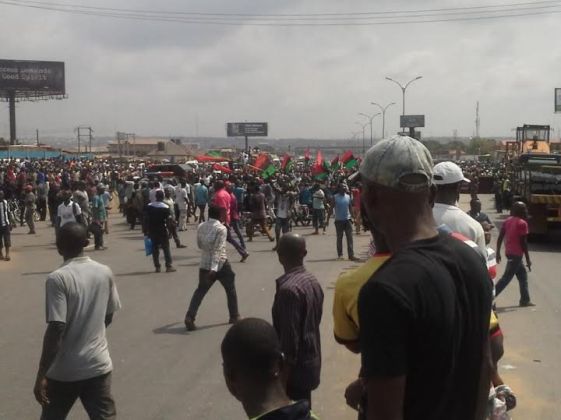
IGP warns Massob, Biafran protesters, says stop threatening public peace or face the wrath of the law

The Inspector-General of Police, IGP Solomon Arase has issued a stern warning to MASSOB and IPOB activists to stop threatening public peace or face the full weight of the law. The warning followed the observation by the Nigeria Police Force leadership of the increasing resort to acts of brigandage by sets of misguided individuals who apparently are hiding under the cloak of Movement for the Actualisation of Sovereign State of Biafra (MASSOB) and Indigenous People of Biafra (IPOB) to threaten national security and public peace in parts of South East geopolitical Zone and some other conterminous States.

The latest manifestation of this threat is the attempt to blockade the Onitsha end of Niger Bridge on 1st December, 2015, an action that caused major hardship to innocent and law abiding motorists, and citizens. The act also occasioned serious dislocation of business activities. The Inspector-General of Police notes that the increasing resort to acts of brigandage of this nature is pointing to a clear attempt by the brains behind these protests to test the will of security agencies to restore order and guarantee internal cohesion. For the avoidance of doubts, the IGP further notes, the restoration and maintenance of law and public order, and protection of lives and property remain sacred and statutory Mandate of the Nigeria Police. This Mandate, according to him, shall be fully executed in the overriding interests of the nation and vast majority of citizens and residents of the South East geopolitical Zone. Consequently, the Inspector-General of Police has directed the mobilisation and deployment of Police Mobile Force (PMF) across the country to reinforce security in the State Commands that MASSOB and IPOB are currently attempting to utilise as launching pad for their sinister intentions. The Assistant Inspectors – General of Police Zone 5, (Benin); Zone 6, (Calabar) and Zone 9 (Umuahia) as well as all Commissioners of Police in the affected States in the South East and neigbouring States have also been directed to henceforth maximally exercise their statutory Mandate in relation to prevention and disruption of any gathering that threatens public order and national cohesion. Any person or group of persons so arrested in furtherance to the enforcement of this order will be made to face the full wrath of the law. To this end, the Inspector-General of Police advises parents and guardians to call their children and wards to order as the patience of the Force is being stretched to the limit. He firmly affirmed that no individual or group interest can override the interest of the nation and that democratic values provide for exploration of rule of law to advance any concern, not the resort to endless and misguided acts of brigandage, unless there is an ulterior motive as the extant instance tends to dictate. He concluded by asserting that the Nigeria Police Force will not fold its law enforcement arms to allow few misguided elements to continually force hardships on fellow Nigerians either in the South East or any other part of the nation for that matter.

Ag. ACP OLABISI KOLAWOLE
FORCE PUBLIC RELATIONS OFFICER,
FORCE HEADQUARTERS,
ABUJA

Tuesday, 1 December 2015

Court Restrains Prosecution Of Synagogue Collapsed Building Engineers

The Federal High Court sitting in Lagos has restrained the Lagos State Government from prosecuting the two engineers who built the collapsed guest house of the Synagogue Church of All Nations.

Justice Ibrahim Buba on Tuesday granted an order of injunction barring the Commissioner of Police from arresting and detaining the two men.

The judge gave the ruling on an application for an injunction pending the appeal filed by the engineers.

In an earlier judgement on Fundamental Rights Enforcement suit filed by the engineers to stop their prosecution by the Government, Justice Buba held that the men “had not made a case for infringement of their fundamental human rights even on the merit of the application”.

He dismissed their applications on November 11, 2015 paving the way for their arraignment and trial.

The engineers have, however, approached the court of appeal to challenge this ruling.

Justice Buba, who granted their application to stay the proceedings against them by the Lagos State Government, said his ruling would subsist until the engineers’ appeal against his earlier ruling was determined by the Court of Appeal.

He urged the prosecution to ensure that the appeal was heard expeditiously and threatened to vacate the restraining order if the engineers failed to prosecute their appeal promptly.

On Monday the Lagos State government had sought to arraign both men, their engineering company, Hardrock Construction Company, one Jadyn Trust Limited and the registered trustees of the Synagogue Church before a Lagos High Court sitting in Ikeja.

The State government slammed a 111-count charge against them.

Their arraignment was however stalled owing to the absence of both men & their company in court.

- Channels TV

Bobbi Kristina Brown: Yahoo's Most Searched Person in 2015

Yahoo has released a year end recap revealing the most searched people, terms, questions, and more in 2015.

Bobbi Kristina Brown, the late daughter of Whitney Houston who tragically died this year, was the top search overall. She also topped the list of the most searched female celebrities.

Scott Disick was the top searched male celebrity of the year and six of the top 20 searched celebrities (male and female) were part of the Kardashian extended family. Members of the family also took up six slots on the top ten searched reality TV stars.


Top Searches on Yahoo in 2015:
1. Bobbi Kristina Brown
2. iPhone
3. Caitlyn Jenner
4. Kendall Jenner
5. Minecraft
6. Jennifer Aniston
7. Kim Kardashian
8. Katy Perry
9. Ronda Rousey
10. Farrah Abraham

Top Searched Male Celebrities on Yahoo in 2015:
1. Scott Disick
2. Lamar Odom
3. Tiger Woods
4. Justin Bieber
5. Tim Tebow
6. Kanye West
7. Peyton Manning
8. Josh Duggar
9. Ben Affleck
10. Robin Williams

Top Searched Female Celebrities on Yahoo in 2015:
1. Bobbi Kristina Brown
2. Caitlyn Jenner
3. Kendall Jenner
4. Jennifer Aniston
5. Kim Kardashian
6. Katy Perry
7. Ronda Rousey
8. Farrah Abraham
9. Britney Spears
10. Scarlett Johansson

Top Search Reality TV Star on Yahoo in 2015:
1. Caitlyn Jenner
2. Kendall Jenner
3. Kim Kardashian
4. Farrah Abraham
5. Kendra Wilkinson
6. Jessa Duggar
7. Scott Disick
8. Jill Duggar
9. Kourtney Kardashian
10. Khloe Kardashian


David, Yolanda Foster to divorce after four years of marriage

Yolanda Foster and her husband David Foster have announced that they are getting divorced after four years of marriage - in November 2011.

''Sadly we have decided to go our separate ways,'' the couple told People in a joint statement. ''We’ve shared 9 beautiful and joyous years together. During that time we experienced love, friendship and the inevitable challenges that come with managing a marriage, careers, blended families and health issues. We are grateful for the years we’ve spent together and believe whole heartedly that we did our best. I hope that we can pave the road ahead of us with all we’ve learned and with the love and respect we will always have for one another.''

Mark Zuckerberg, wife Chan pledge 99% of their Facebook shares to charity as they welcome their first child together!

Facebook founder Mark Zuckerberg and his wife Priscilla Chan have welcomed a baby girl, Max into the world!

Announcing the birth, the happy couple wrote a letter to their daughter giving away 99% of their shares in the company to charity.

''Priscilla and I are so happy to welcome our daughter Max into this world! For her birth, we wrote a letter to her about the world we hope she grows up in,'' Mark announced on his Facebook page.

''As you begin the next generation of the Chan Zuckerberg family, we also begin the Chan Zuckerberg Initiative to join people across the world to advance human potential and promote equality for all children in the next generation. Our initial areas of focus will be personalized learning, curing disease, connecting people and building strong communities,'' Mark and Priscilla wrote. ''We will give 99% of our Facebook shares — currently about $45 billion — during our lives to advance this mission. We know this is a small contribution compared to all the resources and talents of those already working on these issues. But we want to do what we can, working alongside many others.''

The entire letter to Max is quite lengthy. You can read it in full over on Facebook.

Congrats Mark and Chan!

PDP condemns Raymond Dokpesi’s arrest

The Peoples Democratic Party (PDP) condemns in its entirety, the arrest of media mogul, High Chief Raymond Dokpesi and other opposition elements  by the APC-led Federal Government.

The party also alerted that it has been made aware that more notable PDP leaders have similarly been listed for arrest over unproven allegations pursuant to the plot by the APC to cow and silence opposition in the country.

PDP National Publicity Secretary, Chief Olisa Metuh in a statement on Tuesday said the military style of pronouncement of guilt on Chief Dokpesi before any fair hearing, betrays the fact that he is a victim of political persecution and mob trial by the APC government because of his association with the PDP.

“While the PDP is not against the war against corruption, we insist that the crusade must be carried out within the limits of the law and not as a guise to persecute and torture opposition elements in the country.

“Our fear is that with the pronouncement of guilt even without being giving the opportunity within his rights as a citizen to state his own side of the story, the President Buhari-led government is sidestepping the laws to ensure that Chief Dokpesi does not get justice in the court, a plot which they want to extend to other PDP leaders.

“The PDP therefore demands an open and public trial of all those arrested so that all issues and charges against them as well as their defence therein would also be in the public domain. We demand a proper investigation and lawful prosecution instead of the reprehensible resort to outright political persecution, which can only have a place in a military regime.

“We also note that this development may not be unconnected with the planned onslaught against the media, following its commitment in holding this dictatorial regime accountable since it took office.

“Finally, we call on the international community and rights bodies worldwide to note the growing impunity and gross violation of human rights by the President Muhammadu Buhari-led government tailored to decimate the opposition and cow the media in Nigeria.

Mugabe welcomes China's Xi in rare VIP visit

China's President Xi Jinping arrived in Zimbabwe on Tuesday on a rare visit by a world leader to a country shunned by Western powers over President Robert Mugabe's widely-criticised record on human rights.

Xi was greeted at the airport by Mugabe, 91, who has ruled since independence in 1980, as hundreds of children waved miniature Chinese and Zimbabwean flags along the road into the capital Harare.

The two leaders will hold talks before attending a state banquet, with new Chinese investments likely to be announced to support Zimbabwe's economy, which has fallen into dire straits under Mugabe's rule.

Mugabe's wife Grace was part of the welcoming party for Xi, who was accompanied by Chinese first lady Peng Liyuan.

Xi is the most prominent leader for many years to visit Zimbabwe -- a diplomatic coup for Mugabe who has fostered ties with China since Beijing backed several African movements fighting to end colonial rule.

"We already have more than 100 Chinese companies who have invested in Zimbabwe and there is a lot of interest in all sectors of the economy from Chinese investors," Finance Minister Patrick Chinamasa told reporters.

"This visit gives a guide to Chinese investors that Zimbabwe is a safe destination for their investments."

China is the largest buyer of tobacco from Zimbabwe, and -- as in many African countries -- has invested in mining, manufacturing and infrastructure.

China built Zimbabwe's National Sports Stadium in the 1980s, as well as rural hospitals and the country's biggest shopping mall, and also provided loans for water schemes and power stations.

- 'Little improvement' -

But analysts say Zimbabwe's economic troubles, which saw inflation soar to 500 billion percent during a decade-long recession that ended 2009, are unlikely to be solved by new Chinese investments.

"It's not going to change our economic fortunes in the short-term," Antony Hawkins, an economist at the University of Zimbabwe's School of Business, told AFP.

"Considering what has happened with past deals, we are sceptical of promises of big, megaprojects. We have had a lot of Chinese involvement before, but little improvement has happened."

Mugabe, who has often been accused of heading a repressive regime, was in October awarded the Confucius Peace Prize, a would-be Chinese rival to the Nobel Prize.

"This so?called historic state visit is in actual fact a public relations exercise that will not bring any meaningful and tangible benefits to the tottering economy of Zimbabwe," the opposition MDC party said in a statement.

On Wednesday, Xi is expected to visit the Heroes Acre memorial site that honours Zimbabwe's war dead before he flies to Johannesburg ahead of the sixth Forum on China-Africa Cooperation (FOCAC).

The summit, which will gather leaders from across Africa, comes amid growing African concern over the impact of the Chinese economic slowdown.

Seeking raw material to fuel its booming economy, China has poured investment into Africa and became the continent's largest trade partner in 2009.

But Chinese investment in Africa fell by more than 40 percent in the first half of 2015 due to its reduced demand for commodities such as oil, iron ore and copper.

Before the two-day summit begins on Friday, Xi will hold talks with South African President Jacob Zuma.

Xi, Mugabe and Zuma attended the opening of the climate change summit in Paris on Monday.


Blast hits Istanbul metro, bomb suspected

A station on the Istanbul metro was Tuesday rocked by a blast suspected to have been caused by a home-made bomb, causing panic in the evening rush hour and wounding up to half a dozen people.

There was no word from federal officials over the cause of the blast but the local mayor and Turkish news reports said that it had likely been caused by a bomb.

The huge blast hit an overpass close to the metro station in the Bayrampasa district of Istanbul.

"Five of our citizens were injured when a pipe bomb left on barriers on the overpass exploded," Atilla Aydiner, the district mayor, told A Haber television.

Security sources were also quoted by the Dogan news agency as saying the blast appeared to have been caused by a home-made bomb.

The metro system in Turkey's largest city was brought entirely to a halt after the blast, the municipality said, although reports said that normal service was now being restored.

Other reports had said the cause of the blast could have been linked to an electrical transformer and that six people had been injured.

Video footage on Dogan showed large sparks shooting out like fireworks from the overpass, lighting up the sky near the height of evening rush hour.

Dogan also said a truck on the overpass was damaged by the explosion with holes on its windshield while other pictures showed a public bus with blown-out windows.

Large numbers of ambulances were dispatched to the scene, as commuters were helped to safety, reports said.

"The cause of the explosion is not clear. We are investigating all possibilities," Istanbul governor Vasip Sahin was quoted as saying by the state-run Anatolia news agency.

He gave a lower toll of just one person injured.

- AFP

Buhari, Osinbajo, Queen Elizabeth, others to attend Ooni Ogunwusi's coronation

Several dignitaries are expected to attend the final coronation of the new Ooni of Ife. They include President Buhari, Vice President Yemi Osinbajo, Senate President Bukola Saraki and House of Representatives Speaker Yakubu Dogara as well as the Queen of England.

The over one week event will climax next Monday with the presentation of staff of office by Osun State Governor Rauf Aregbesola.

Addressing a pre-coronation briefing at the palace yesterday, the monarch’s elder brother, Prince Adegboyega, said invites have been sent to 27 governors, members of the National Assembly and other dignitaries.

''There will be a coronation carnival round the town today. Tomorrow, there will be artistes’ coronation day,'' he said. ''On Thursday, there will be traditional worshippers’ day. A Jumat service will hold on Friday. Also on that day, there will be a youth carnival and fashion parade. A football match between Ajiroba FC and Shooting Stars of Ibadan is scheduled for Saturday. On Sunday, there will be an interdenominational service at Enuwa Square and inauguration of Ife Resorts. The grand finale is on Monday with the presentation of staff of office. The programme will be rounded off on December 13 with a thanksgiving service at St. Saviour Anglican Church, Ayegbaju, Ile-Ife.''

The Chairman, Publicity Committee, Biyi Odunlade, said December 7 has been declared a public holiday to allow residents participate in the programme.

According to Odunlade, the event will be historic.

Ijaw Group accuses Police of cover up in attack on Jonathan

The Ijaw National Frontiers (INF) has called on the Inspector General of Police, IGP Solomon Arase to investigate an attempt by the Bayelsa State Police Command to cover up the facts about the alleged attack on the former President Goodluck Jonathan on Monday.

''We were shocked at the defence put up by the police in Bayelsa through the command’s public relations officer, that the arrested gang members are not militants but rather some set of hungry youths, who mistook Jonathan’s convoy for that of the gubernatorial candidate of the APC, Chief Timipre Sylva,'' the INF coordinator, Dr Esther Atani in Yenagoa said in a statement issued on Tuesday.

''As Bayelsans, we are familiar with several of the elements being used as political thugs by politicians and we make bold to say, that two members of the arrested gang are renowned militants from the Nembe area of the state, who have various criminal records, even with the police,” she said.

The group further said the action of the police in Bayelsa was a pointer to the fact that the security agency would likely be partisan in the days ahead of the governorship election in the state.

''We, therefore, call on all Nigerians of good conscience to join in demanding a thorough investigation into the attempted attack on Dr. Goodluck Jonathan since it is hard to believe that the police would join in insinuating that those youths were unfamiliar with Dr. Jonathan’s residence and so mistakenly followed him to the point of entering.

''We also demand fairness from the police and other security agencies in their conduct before, during and after the December 5 governorship election in the state.

We must all rise to defend Nigeria’s Democracy,'' the statement said.


EFCC arrests former Daar Communications Chairman, Raymond Dokpesi

The Economic and Financial Crimes Commission, EFCC, says it has arrested the former Chairman of Daar Communications, Chief Raymond Dokpesi.

He was picked up in Abuja at about noon on Tuesday and was accompanied to the office of the EFCC by his son Raymond Dokpesi Jnr., who is the current Chairman of Daar Communications.

The Head of Media in the EFCC, Wilson Uwujaren, told Channels Television that Chief Dokpesi was arrested in connection with money disbursed from the office of the former National Security Adviser, Sambo Dasuki.

He said that there was no explanation about what the money was meant for and it was pathetic that the office of the NSA was used as “a warehouse to dish out money to people”.

He added that very worrisome is that this hard-earned money is taken from the coffers of the country.

James Faleke sues INEC, asks Court to declare him Kogi's governor-elect

Late Prince Abubakar Audu's running mate, James Faleke (pictured) has filed a suit at the Federal High Court sitting in Abuja on Tuesday, challenging the All Progressives Congress' choice Yahaya Bello who was picked on Monday to replace Audu for the Kogi Supplementary Election.

According to the Premium Times, in the suit, Faleke was demanding that the Independent National Electoral Commission (INEC) declare him as governor-elect.

Revival of Lake Chad will reduce migration to Europe - Buhari tells world leaders at climate summit in Paris

President  Buhari on Tuesday in Paris asked developed countries to make strong financial commitments to the 14 billion dollars urgently needed to revive the Lake Chad and save communities dependent on the river from extinction.

Addressing a high level meeting on “Climate Change Challenges and Solutions in Africa’’, on the sidelines of the on-going UN Climate Change Conference, COP 21, President Buhari said no fewer than five million people living in the Lake Chad Basin countries have been displaced by the depletion of the lake due to climate change.

The President said the shrinkage of Lake Chad, a former island sea, had resulted in increased social conflicts, high rates of migration and cross border movements.

“Nigeria has a large population of over 170 million people and in some parts of Northern Nigeria, a farm that used to belong to 10 people now belongs to over 100 people. They have no other place to live and no land for cultivation,’’ he said.

President Buhari recalled that a research conducted by a professor in a London university and published more than three decades ago had predicted that unless one or some of the rivers from the Central African region are diverted to empty into the Lake Chad basin, the river will dry up.

He noted that sadly that prediction has become reality as the lake which covers over 25,000 square kilometers in 1925 have shrunk to 2,500 square kilometers.

“The amount of resources required and the high technological expertise and infrastructure needed to be undertaken to revive the Lake Chad has to be mainly financed by the G7 and the United States.

“The cost is great and more than 14 billion dollars is needed to revive the Lake.

“But if that is achieved, at least five million people from Central African Republic to the Lake Chad Basin countries (Chad, Niger, Nigeria and Benin) will be rehabilitated.

“When this is done those who are daring to cross the Sahara desert and the Mediterranean to come to Europe will remain at home because they have land where they can cultivate and earn a respectable living,’’ he said.

President Buhari used the occasion of his address on the second day of the climate change conference to reiterate his appeal to leaders from the developed countries to make revival of the Lake Chad a top priority.

On Nigeria’s plans to tackle climate change, President Buhari told the meeting attended by the French President, UN Secretary-General and several African leaders that the country was blessed with natural gas to boost the country’s energy needs.

He said although the technology to optimally utilize natural gas in the country was expensive for the country to maintain, Nigeria welcomes international partnerships and initiatives for lower carbon in the oil and gas sector that focuses on reducing natural gas flaring and capturing the product for commercial use.

Recognizing the acute threats that climate change posed to Nigeria’s development, President Buhari said his administration was ready to embrace several opportunities presented by the challenges posed by climate change.

Nigeria, South Africa rank among most corrupt countries in Africa - Transparency International

A watchdog group, Transparency International (TI) says Nigeria is among the most corrupt countries in Africa, raking South Africa first on the list along with Sierra Leone, Ghana and Liberia.

The group in its latest report released on Tuesday in Johannesburg said from investigation, an estimated 75 million people in Africa gave bribe last year.

The group report said Word Bank data showed that Sub-Saharan Africa has a total population of 973 million, and more than 22 per cent of Africans who came into contact with public service in the past 12 months paid a bribe.

 It said that interview with 43,143 people showed that police and courts had the highest corruption rates, adding that in 18 out of the 28 countries surveyed, majority of the respondents said they believe their government was doing badly in tackling the issue of corruption.

The survey said the slow response to the Ebola outbreak in Liberia and Sierra Leone may have been caused by endemic corruption in governmental circles.

Most of the respondents said corruption in their countries was most evident in the police, among business executives, government officials and the courts.

Many Nigerians interviewed equally said that they believe the government was not doing enough to tackle corruption.

However, only in countries like Botswana, Swaziland and Lesotho did citizens say they believed the government was trying its best in tackling corruption.

In Botswana, 54 percent of respondents gave the government a pass mark in the fight against corruption.

German cabinet approves plans to send 1200 troops to fight ISIS in Syria

German cabinet has approved plans to send up to 1,200 troops, a naval frigate and Tornado reconnaissance aircraft to the Middle East as part of a multi-million euro mission to support the fight against Isis.

Germany decided to join the fight against IS after an appeal by French President Francois Hollande in the wake of the 13 November Paris attacks.

Its forces will not engage in combat/airstrikes.

The mission is expected to go for a parliament vote as early as Wednesday.


Jonathan Commissions 1st Bayelsa Flyover

Former Nigerian President Jonathan on Monday commissioned a flyover to be constructed in Yenagoa, Bayelsa State capital.

The project is poised to bring relief to the usual traffic gridlock experienced along the Ox-Bow Lake axis of the state capital which is one of the star projects of the Bayelsa Governor Seriake Dickson.

Also commissioned is the Azikoro Road dualisation project which brought respite to road users in the heart of the state capital.

Acting Chairman of the Peoples Democratic Party, Uche Secondus, who commissioned the dualised Azikoro Road, urged Bayelsans to reciprocate the developmental strides of the Governor by casting their votes in his favor on December 5.

Police release suspected men who chased ex-president Jonathan's convoy in Bayelsa (Photos)

Nigerian Police have released a photo of the suspected four men who allegedly trailed former President Jonathan in Bayelsa on Monday November 30.

The four men were said to have chased Jonathan’s convoy from the Julius Berger bridge area of Yenagoa to the entrance of his home in the Kpansia area but were subsequently overpowered by the former president’s security detail and handed to the police.


Buhari's wife Buhari visits Dubai Prime Minister's wife Haiya

Nigerian President's wife Aisha Buhari in a group photo with the Dubai Prime Minister's wife, Her Royal Highness Princess Sheha Haiya (second left) on Tuesday during Aisha's visit.


Buhari congratulates Roch Marc Christian kabore on his election as President of Burkina Faso

President Buhari on Tuesday congratulates Roch Marc Christian Kabore of the Movement of People for Progress Party on his historic election as the second civilian President of Burkina Faso.

Buhari believes that the successful conclusion of the electoral process will usher in a new era of true democracy and inclusive good governance in Burkina Faso.

The President appreciates the commitment of the people of Burkina Faso in ensuring a peaceful election and calls on them to continue to give the new leader the maximum support he needs to take Burkina Faso to the country of their dreams.

 He also praises the outgoing transition President, Mr. Michel Kafando for his tenacity and determination in ensuring that the electoral process was concluded amicably in the face of daunting challenges.

 He calls on Mr Kabore to use his famed democratic credentials and vast parliamentary experience to join hands with other contestants to work together for the peace, progress, prosperity and unity of Burkina Faso.

Buhari also uses the opportunity to call on fellow African leaders to continue to sustain the democratic principles sweeping across the continent, and particularly commends the courage and perseverance of ECOWAS leaders for their support in ensuring that the transition and election processes were fully concluded and believes that the success of the Burkina Faso election will deepen the democratic processes in Africa and emphasize regional and continental integration.

President Buhari once again wishes Mr. Roch Marc Kabore a successful tenure particularly in his service to the people of Burkina Faso and to the global community in general.

Lai Mohammed: ‘This government will not give excuses’

Nigerian  Minister of Information and Culture Lai Mohammed says the APC-led government will work to fulfill all its promises and not give excuses.

''This Government will not give excuses,'' the Minister said at a meeting with representatives of Civil Society Organizations (CSOs) in Abuja on Tuesday. ''The painstaking and methodical approach by the Buhari Administration, its deep analysis and understanding of the challenges and the recent inauguration of the cabinet will herald a new dawn.''

He added, ''Nigerians will witness measurable and impactful progress in all spheres of governance. We shall not abandon our social intervention policies such as one meal a day for school children and the payment of 5,000 Naira each to vulnerable Nigerians. We are committed to lifting millions of Nigerians out of poverty.''

Governor Fayose slams Buhari's poor leadership in 6-months in full page advert (Photo)

The Ekiti state Governor Ayodele Fayose on Tuesday took a full page advert in one of Nigerian dailies to slam  President Buhari over his poor leadership since assuming office on May 29 this year.

Pro-Biafra protesters block Onitsha-Owerri Expressway (Photos)

South East's Pro-Biafria protesters Tuesday morning have blocked the Onitsha-Owerri expressway as they held a mass rally calling for their agitation to be fulfilled.

The group leaders ordered all shops in Owerri and Onitsha to be locked so that they can all participate in the rally.


Source: LIB

SSS arrest Former NSA, Dasuki Sambo

Operatives of the State Security Service, SSS, Tuesday morning arrested the former National Security Adviser, Sambo Dasuki, driving him away from his Abuja residence.

According to report, Dasuki was driven to the SSS headquarters in the Asokoro District of Abuja.

 Dasuki was first arrested by the SSS in July after a prolonged siege on his Abuja home. He was charged to court with illegal possession of arms and money laundering.

His arrest came after a Former Minister of State for Finance Bashir Yuguda and 20 others who worked closely with the former NSA were on Monday November 30  arrested and interrogated on the procurement of arms to the tune of $2.1 billion during the Former President  Jonathan's administration.

Erdogan says would resign if Putin IS oil trade claims proven

Turkish President Recep Tayyip Erdogan on Monday said he would be ready to quit office if allegations by Russian counterpart Vladimir Putin that Turkey traded oil with Islamic State (IS) jihadists were proven.

"I will say something very strong here. If such a thing is proven, the nobility of our nation would require that I would not stay in office," Erdogan was quoted by the state-run Anatolia news agency as saying on the sidelines of the UN climate talks near Paris, which Putin is also attending.

Challenging Putin, who has refused to meet the Turkish leader after the shooting down of a Russian military jet, Erdogan added: "And I tell Mr Putin 'would you stay in that office?' I say this clearly."

Putin earlier Monday accused Ankara of shooting down the Russian Su-24 warplane last week to protect supplies of oil from the Islamic State group to Turkey, charges Turkey vehemently denies.

"Let's remain patient and let's not act emotionally," said Erdogan.

Erdogan said that Turkey obtained all its oil and gas imports "though the legal path".

"We are not dishonest so as to do this kind of exchange with terrorist groups. Everyone needs to know this."

After the Su-24 bomber was downed on the Syrian border last week, Putin accused the Turks of being "accomplices of terrorists" and said oil from IS territory was being exported through Turkey.

- AFP

LinkWithin

Related Posts Plugin for WordPress, Blogger...